
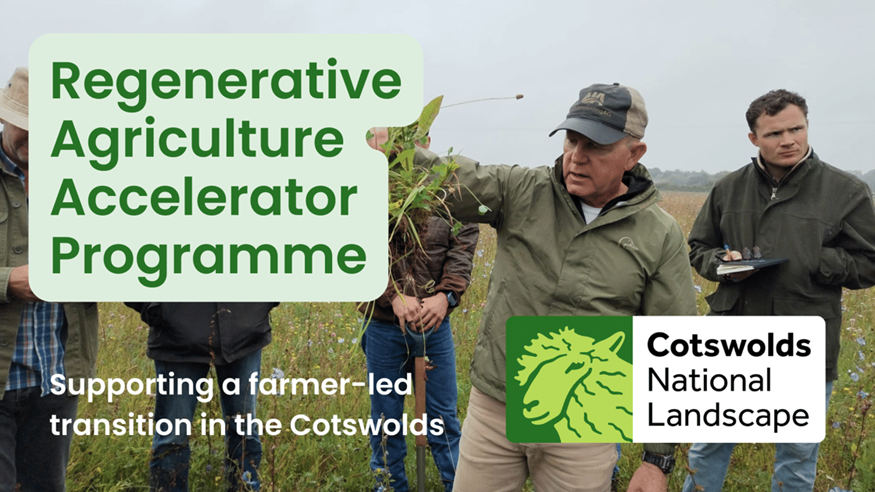
Apply now to join The RAAP Cotswolds in 2026
The Regenerative Agriculture Accelerator Programme (RAAP) is an innovative initiative for farmers and advisors who want to deepen their understanding of regenerative and agroecological principles – and learn how to apply them in practice to produce nutritious food, improve soil health, boost biodiversity, and build farm resilience. The application window is now open for those interested in joining the 2026/27 Cotswolds cohort.
Programme overview
The transition to a regenerative farming and agroecological future is a deep and complex journey. High levels of motivation, knowledge and confidence are required to successfully put the key principles into practice. The barriers and journey can be overwhelming, and pioneers can feel isolated. The RAAP has been created to change this!
The mission of the programme is to accelerate and deepen the adoption of regenerative farming practice and agroecological thinking in the Cotswolds, improving soil health, enhancing biodiversity and building resilience. If you are accepted you will benefit from over 120 hours of learning, most of which is free.
The unique, fun, and high impact programme includes farm walks, guest speakers, technical workshops, agronomy clinics, meet ups at Groundswell and other relevant events, and mentoring.
Over the last two years, participants have benefited from sessions with Gabe Brown, Allen Williams, Carolyn Grindrod, Niels Corfield, Tim Williams, Tim Parton, Chris Clarke, Ed Horton, Silas Hedley-Lawrence and Anna Jones to name just a few, exploring a diverse range subjects from soil health, biological farming, Maximum Sustainable Output and regenerative grazing to communication and facilitation.
Participants will also have the chance to attend workshops focused on media/communications, project management and rural facilitation, and will be invited to help organise the second Cotswolds Regenerative Agriculture Conference in 2027.
A number of the programme’s key elements and events will be opened up to other farmers and advisers from across the region, engaging a wider audience.
This innovative and intensive 12-month opportunity is hosted by Cotswolds National Landscape (CNL) and funded by a Farming in Protected Landscapes (FiPL) grant.
Get involved
If you are a farmer or adviser in the Cotswolds, with an interest in regenerative agriculture and agroecology, and have a thirst for knowledge, the organisers would love to hear from you!
Learn more about the Programme and apply here.
If you would like to discuss the programme in more detail, please email Jonty Brunyee at jonathan@conygreefarm.co.uk